Men's Safari Jacket: 5 Outfits and When Bespoke Matters
A safari jacket is a lightweight, belted, four-pocket jacket built on a shirt collar and epaulettes, born from British colonial khaki drill and now one of the sharpest alternatives to an unstructured blazer. Wear one over a T-shirt for the weekend or under a linen shirt for smart-casual travel, and it carries both registers without effort. This guide traces the safari jacket style from its military origins to its bespoke potential, covering fabric, fit, styling and the occasions where it earns its keep.
TL;DR:
- Heavier cotton drill fabric provides structure and durability, making the jacket sharper and more resistant to collapsing into shapelessness.
- Linen offers the coolest option for hot climates but is prone to creasing and softening, requiring careful packing and gentle cleaning.
- Bespoke tailoring ensures proper pocket placement, belt height, and fit, which is crucial due to the jacket’s functional design and multiple compartments.
- Modern variations feature shorter lengths, new colors, and reduced pocket counts, expanding styling versatility beyond traditional military hues.
- Accessories should be restrained, with contrasting footwear and minimal bags, to maintain the jacket’s sharp yet relaxed aesthetic.
Table of Contents
- What defines the safari jacket style and where did it originate?
- Which fabric and construction suit a modern safari jacket?
- How to wear a safari jacket without it looking like a costume
- Getting the fit right: off-the-rack versus bespoke
- Caring for cotton drill and linen safari jackets
- Five outfit prompts to try this season
- Where a safari jacket actually earns its place
- Modern variations on the classic safari silhouette
- How to accessorize a safari jacket
- Why the safari jacket deserves a tailor’s attention
- Bring your safari jacket to life with bespoke tailoring
- Sources
- FAQ
What defines the safari jacket style and where did it originate?
The safari jacket traces to British Army khaki drill uniforms worn during the Second Boer War, when practicality dictated the design more than fashion did. The term “safari suit” itself entered the language in 1935, and the Oxford English Dictionary’s historical record ties the garment firmly to early twentieth century expedition dress. Ernest Hemingway did more than anyone to popularise the bush jacket in that same decade, wearing his on hunting trips through East Africa until the image of the rugged, khaki-clad writer became inseparable from the jacket itself.
The 1960s changed everything. Yves Saint Laurent reworked the safari jacket for haute couture in his 1968 collection, stripping away its purely functional intent and turning it into something desirable in its own right. That moment, as Esquire’s history of the style notes, made the jacket unisex and aspirational rather than merely practical. Italian tailors later softened the silhouette further into the sahariana, a version that keeps the military details visually but refines the construction for comfort.
Whichever era you look to, four features recur:
- Four bellows pockets, patch-style and expandable, on the chest and hips
- A self-fabric or cloth belt, sometimes worn loose rather than cinched
- Epaulettes at the shoulder, a holdover from military rank insignia
- An open, shirt-style collar rather than a structured lapel
Which fabric and construction suit a modern safari jacket?
Fabric weight decides whether the jacket holds its shape or collapses into something shapeless. Cotton drill in the region of 8 to 11 ounces gives enough body to keep the pockets sitting flat and the belt sitting correctly, according to The Gentleman’s Journal’s guidance on safari cloth. Anything much lighter risks a floppy, undefined front, which undermines the whole point of the design.
Linen offers a cooler alternative for genuinely hot climates, though it creases more readily and softens the structure noticeably. Tropical wool sits between the two: it drapes better than drill, resists creasing better than linen, and photographs well in half-belted, unstructured builds.
Construction matters as much as cloth. An unstructured build with a soft chest and minimal shoulder padding, paired with a half-belt rather than a full one, keeps the jacket wearable in warm climates while still reading as tailored, a point Country & Town House makes when discussing the sahariana’s appeal.
- Heavier drill: sharper silhouette, better pocket definition, warmer to wear
- Linen: coolest option, most prone to creasing, softest drape
- Tropical wool: balanced choice for year-round versatility
Pro Tip: Ask for the belt to be cut from the same bolt of cloth as the jacket rather than a contrasting fabric. It ages and fades at the same rate, so the whole garment develops its patina evenly rather than showing a mismatched belt after a few seasons of wear.
How to wear a safari jacket without it looking like a costume
The line between “sharp” and “fancy dress” comes down to restraint. Pair the jacket with one utilitarian element at most, then let everything else contrast in texture and formality, echoing the caution The Rake gives against full utility dressing.
- Casual weekend: a plain white T-shirt, dark denim, and minimal white trainers. The jacket does all the talking, so keep everything beneath it quiet.
- Smart-casual: an open-collar linen shirt, tailored trousers in a contrasting tone, and loafers or unlined derbies. Leave the belt loose or unbuckled to soften the military edge, and follow the same logic used in smart-casual outfit formulas for balancing structure with ease.
- Warm-weather travel: a lightweight linen or cotton drill jacket, sleeves rolled to the forearm, pale chinos, and minimal leather sandals or loafers. The functional pockets earn their place here, holding a passport or phone without a bag.
What to avoid is just as important as what to wear. Skip full utility kit, cargo trousers, or head-to-toe khaki. Matching the jacket’s colour to your trousers erases the contrast that makes the silhouette interesting in the first place, turning a considered outfit into a uniform. A dark trouser against a sand or olive jacket, or vice versa, does far more for the eye.
Pro Tip: If you own a graphic tee you love, a safari jacket is one of the few structured layers that won’t fight it. Some of the best casual jacket and graphic tee pairings work precisely because the jacket adds shape while the tee keeps things relaxed.
Getting the fit right: off-the-rack versus bespoke
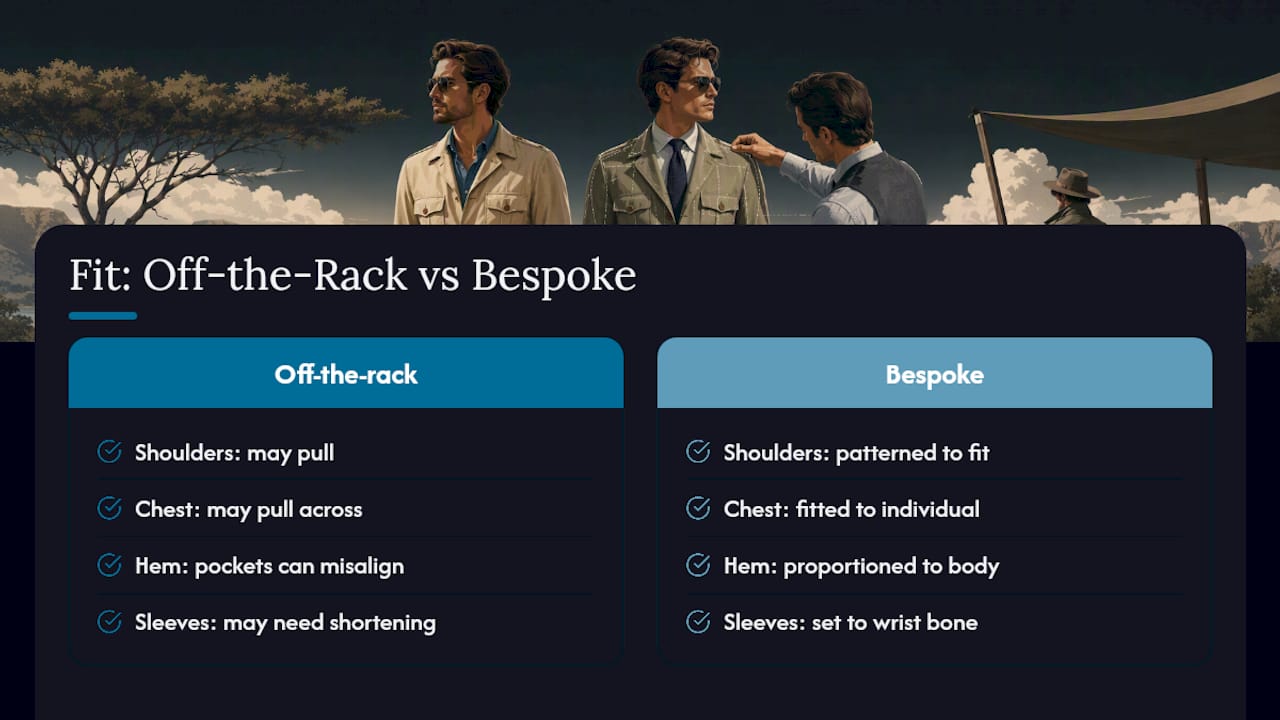
A well-fitted safari jacket sits close at the shoulder with no pulling across the chest, and stops at the hip, roughly where a sport coat would. Sleeves should end at the wrist bone, slightly shorter than a formal suit sleeve, so the cuff doesn’t swallow the hand. The belt is optional rather than compulsory. Broader frames often look better with it worn loose or left unbuckled entirely, while slimmer builds can cinch it for definition without looking costume-like.
Off-the-rack jackets are a reasonable starting point, but the four-pocket geometry is unforgiving. Alter the body width and you risk distorting where the pockets sit relative to the belt, throwing off the whole proportion.
Bespoke tailoring avoids that problem by patterning the jacket around the individual from the outset, keeping pocket placement, belt height, and shoulder line all in proportion to one body rather than a standard block. It also means choosing cloth weight deliberately, whether that’s a substantial drill for structure or a softer tropical wool for an unstructured build closer to the sahariana silhouette described earlier. Ron & Rich’s approach to bespoke suits and jackets applies the same patterning discipline to a safari jacket as to a two-piece suit, which matters more here than in most garments.
A safari jacket rewards a tailor’s eye more than most casual pieces, because four functioning pockets and a belt leave far less room to hide a poor fit than a plain single-breasted jacket does.
Caring for cotton drill and linen safari jackets
Fabric choice dictates the care routine, and getting it wrong shortens the life of the garment fast. Linen creases as a matter of course, so light pressing rather than heavy ironing keeps it presentable without flattening its natural texture. Cotton drill tolerates more robust cleaning, but heavier weights above 10 ounces benefit from specialist pressing to avoid crushing the belt and pocket structure permanently, a distinction FashionBeans draws when comparing the two cloths.
- Spot-clean small marks rather than washing the full jacket where possible
- Brush cotton drill regularly to lift dust before it works into the weave
- Reserve full pressing for a professional rather than a domestic iron
- Fold linen along natural seams when packing to avoid sharp new creases
A gentle patina, the slight fading and softening that comes with wear, is part of the garment’s appeal rather than a flaw to fight. Avoid harsh detergents or repeated machine washing, which strip colour unevenly and weaken the fabric around the pocket stitching faster than natural ageing ever will.
Five outfit prompts to try this season
- Weekend casual: cotton drill jacket, plain grey T-shirt, raw denim, canvas trainers. Let the jacket’s texture do the work against otherwise plain pieces.
- City-smart: tropical wool jacket, open-collar white shirt, dark trousers, suede derbies. Unbuckle the belt for a softer, less regimented line.
- Travel-resort: linen jacket, sleeves rolled, pale linen trousers, leather sandals. Built for heat, and light enough to fold into carry-on luggage.
- Evening-louche: unstructured drill jacket over a silk or fine cotton shirt, tailored trousers, loose tie optional. Belt worn loose rather than cinched.
- Work-appropriate: heavier drill jacket, crisp shirt, tailored trousers, leather loafers. Treat it as a blazer substitute rather than a casual layer here.
Treat these as starting points rather than fixed rules. Substitute a chino for denim, swap loafers for derbies, and the jacket still holds its identity.
Where a safari jacket actually earns its place
The garment’s versatility comes from occasions that sit between formal and casual, where a blazer feels slightly too stiff and a bomber jacket feels slightly too relaxed. Warm-weather travel is the most obvious fit: the jacket’s own pockets replace a bag for a passport, boarding pass, or phone, and its lighter cloth options cope with heat far better than a wool suit jacket ever could.
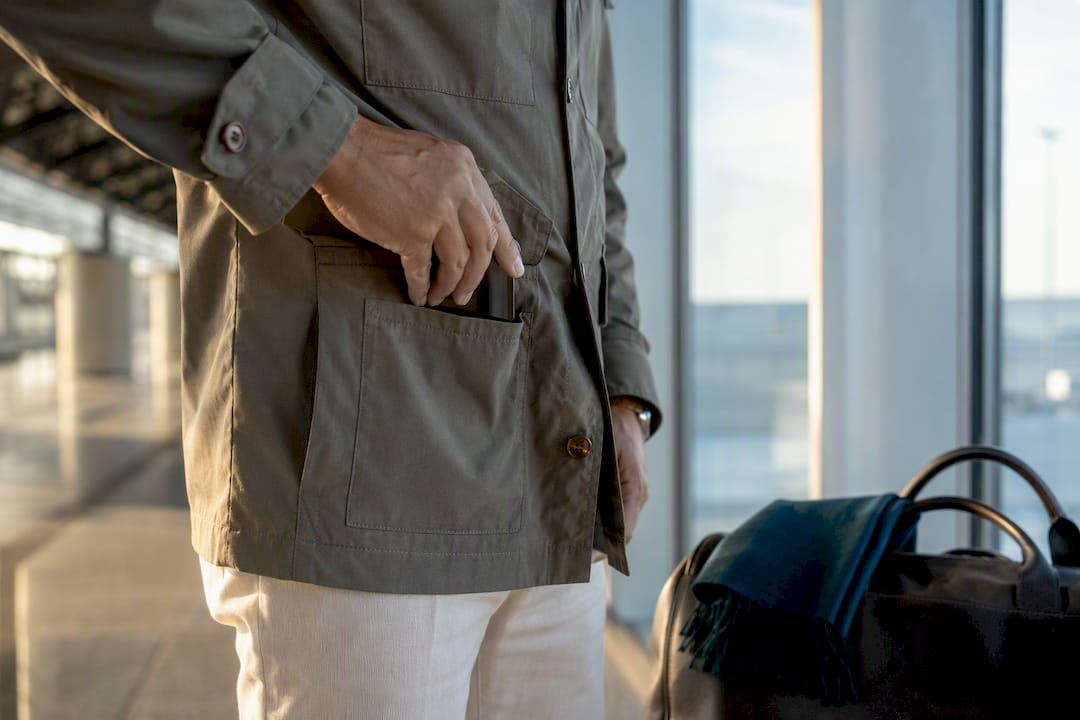
City wear benefits just as much. The jacket’s functional pockets combine with a considered silhouette in a way that suits urban settings, as Country & Town House points out, making it equally credible walking into a casual Friday office or a relaxed dinner reservation. It reads as put-together without tipping into overdressed, which is precisely the gap a blazer sometimes fails to fill in warmer months.
Weekend errands, gallery visits, outdoor markets, and daytime social events all sit comfortably within its range too. Where it struggles is anywhere genuinely formal: black-tie events, courtrooms, or traditional business meetings still call for a structured suit jacket rather than a belted, patch-pocketed alternative. Treat it as the layer for the space between smart and relaxed, not as a replacement for tailoring at its most formal end.
Modern variations on the classic safari silhouette
The sahariana remains the most significant modern adaptation, softening the military original into something closer to an unstructured blazer while keeping the visual cues of pockets, belt and epaulettes intact. It suits warmer climates precisely because it drops the padding and stiffening that a traditional safari jacket once carried.
Designers have also experimented with cropped lengths, cutting the jacket shorter than the traditional hip-length hem for a more contemporary, younger silhouette that pairs well with higher-waisted trousers. Others have stripped back the pocket count from four to two, trading some of the utilitarian character for a cleaner front that reads closer to a standard field jacket.
Colour has moved on from strict khaki and olive too. Contemporary versions appear in navy, stone, rust and even black, which widens how the jacket can be styled against darker trousers or eveningwear without leaning on the original military palette at all. Some versions drop the belt entirely, keeping only the pockets and epaulettes as a nod to the original design while functioning closer to a standard unstructured jacket day to day.
Whichever variation you choose, the core appeal Yves Saint Laurent identified in the 1960s still holds: utilitarian details, rendered in a refined cloth, read as considered rather than costume.
How to accessorize a safari jacket
Restraint governs accessories the same way it governs the rest of the outfit. A wide-brimmed hat or panama works for genuinely warm, resort-style settings, but a baseball cap or beanie suits the jacket just as well in a city context and avoids leaning too hard into safari cliché.
Footwear should contrast rather than match the jacket’s utilitarian mood. Clean white trainers work for casual daytime wear, while suede loafers or unlined derbies suit smart-casual settings far better than boots, which push the look towards workwear rather than tailoring.
Bags need the same consideration. A structured leather tote or a simple crossbody works better than a canvas rucksack, which risks doubling down on the utility theme the jacket already carries. Given the jacket’s own four pockets, many wearers find they need no bag at all for a short outing, which is arguably the most practical accessory decision of the lot.
Keep jewellery and watches understated. A simple leather-strapped watch suits the jacket’s tone far better than anything sporty or ostentatious, and sunglasses in a classic shape, tortoiseshell or metal-framed, round the look off without adding visual noise to an already detailed jacket front.
Why the safari jacket deserves a tailor’s attention
Most menswear advice treats the safari jacket as a novelty piece, something to wear once on holiday and forget. That undersells it. The jacket’s four pockets and belt make fit far less forgiving than a plain blazer, so a poor cut shows immediately in ways a simpler jacket would hide.
Where I disagree with the received wisdom is on cloth weight. Plenty of guides push linen as the default safari fabric because it photographs well in summer campaigns, but a jacket that heavy on pockets needs the structure that only a substantial drill or tropical wool genuinely provides. Get the weight and the tailoring right, and a safari jacket outlasts most trend pieces in a wardrobe by years, not seasons.
— Ron
Bring your safari jacket to life with bespoke tailoring
A well-cut safari jacket is one of the few casual garments where bespoke tailoring changes the outfit rather than just the fit. Off-the-rack sizing forces compromises on pocket placement and belt height that a custom pattern simply avoids, since every proportion is drafted around your own shoulders and waist rather than a standard block.
Safari jackets can be built to a high standard applied to bespoke suits and jackets, working with you on cloth weight, pocket geometry and construction, whether that means a substantial cotton drill for structure or a softer, unstructured sahariana build for warmer wear. Readers who want to see the full range of bespoke suits and jackets can browse the collection online, while those ready to commission a piece can start with the bespoke tailoring process directly. If you would rather buy immediately, the ready-to-wear range offers a faster route into the style without a fitting appointment. Consider booking a consultation to discuss cloth, cut and proportion before your next warm-weather trip or smart-casual event.
Sources
- Safari jacket — Wikipedia
- Safari jacket men — FashionBeans
- How the Safari Jacket Became an Enduring Part of American Style — Esquire
- Style 101: The Safari Jacket — The Rake
FAQ
What is the best jacket to wear on a safari?
A lightweight cotton drill or tropical wool safari jacket in the 8 to 11 ounce range gives enough structure for the pockets and belt to sit correctly without becoming too warm for travel.
How do you style a safari jacket?
Keep the rest of the outfit simple and contrasting: a plain T-shirt with denim for casual wear, or an open-collar shirt with tailored trousers for smart-casual settings, avoiding full utility kit or matching khaki throughout.
What colour is best for a safari jacket?
Traditional khaki, stone and olive remain the most versatile, though contemporary versions in navy, rust or black widen how easily the jacket pairs with darker trousers or eveningwear.
Is the safari suit outdated?
The full matching safari suit reads as dated, but the jacket worn alone with contrasting trousers or denim has stayed current since Yves Saint Laurent’s 1960s reinterpretation, and a well-tailored version remains a credible smart-casual staple today.