French Cuff vs Barrel Cuff: A Man's Style Guide
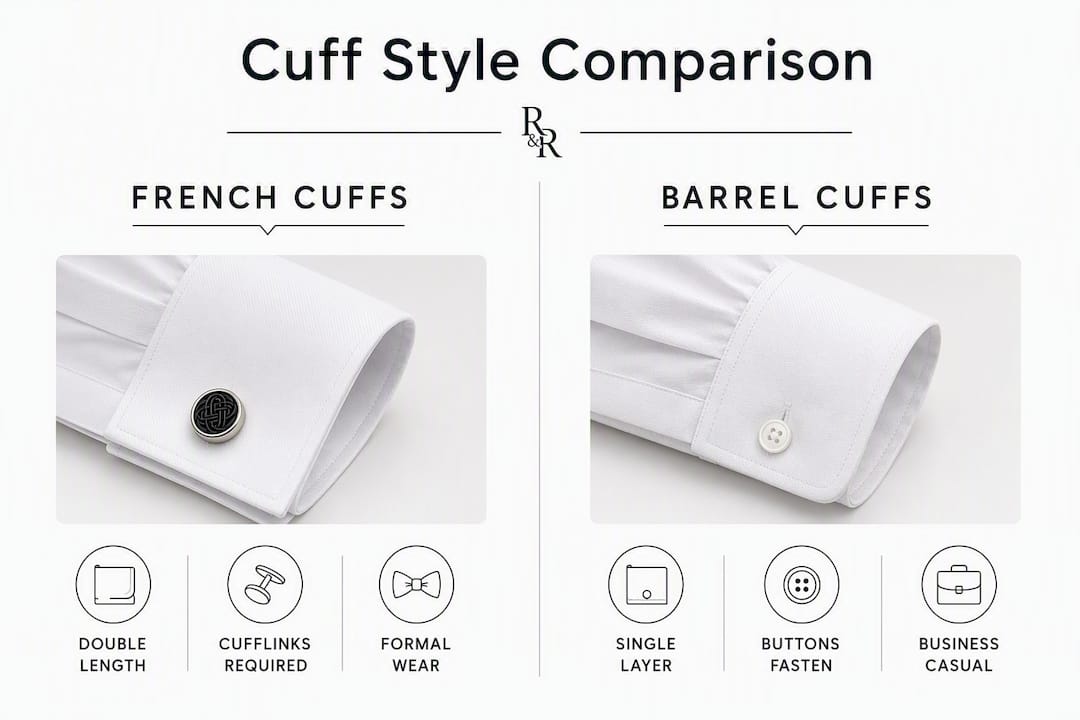
French cuffs are double-length cuffs that fold back on themselves and fasten with cufflinks; barrel cuffs are single-layer and close with one or two sewn-in buttons. The choice between them is largely a question of occasion: reach for French cuffs at black-tie events, weddings, and high-stakes boardroom meetings; keep barrel cuffs for daily office wear, business-casual settings, and travel. Gentleman’s Gazette puts it plainly, barrel cuffs are the everyday choice for most men, while French cuffs signal deliberate formality. At RON & RICH, we see this decision come up in nearly every bespoke shirt consultation, and the right answer always depends on how a man actually lives in his clothes.
Table of Contents
- What does a shirt cuff actually consist of?
- Barrel cuffs: the workhorse of everyday dress shirts
- French cuffs: construction, formality, and how to wear them
- Convertible cuffs and other cuff shapes worth knowing
- Cufflinks: types, how to put them on, and styling rules
- How do you choose between French and barrel cuffs?
- Why bespoke shirts make cuff choices easier
- Key Takeaways
- A tailor’s note on the mistakes men make with French cuffs
- Ronandrich bespoke shirts: getting your cuff fit right
- Useful sources
What does a shirt cuff actually consist of?
A cuff is the band of fabric that encircles the wrist at the end of a sleeve. Every cuff shares a few basic elements: the cuff edge (the outer perimeter), the placket (the folded strip that reinforces the opening), and buttonholes or link holes for fastening. The key structural variable is length. A single-layer cuff wraps the wrist once; a double-length cuff is long enough to fold back, creating two layers of fabric at the wrist.
“Sleeve show” refers to how much shirt cuff is visible below a jacket sleeve. The traditional standard is roughly half an inch of cuff peeking past the jacket’s sleeve end. Too little, and the shirt disappears; too much, and the proportions look off.
- Cuff edge: the finished outer border of the cuff
- Placket: the reinforced strip housing the buttons or link holes
- Buttonholes or link holes: the fastening points
- Cuff length: single (barrel) or double (French)
- Sleeve show: the visible portion of cuff below a jacket sleeve
Pro Tip: If you plan to wear French cuffs regularly, ask your tailor for an extra quarter to half an inch of sleeve length. The folded double cuff adds thickness at the wrist and needs that room to sit cleanly under a jacket.
Barrel cuffs: the workhorse of everyday dress shirts
Barrel cuffs are the most common dress shirt cuff, featuring a single layer of fabric that wraps the wrist and fastens with one or two buttons. The name comes from the cylindrical shape the cuff forms around the wrist. Construction is straightforward: the fabric is cut to a single length, finished at the edges, and fitted with sewn-in buttons. Most dress shirts you pull off a rack will have a barrel cuff.
The practical advantages are real. No cufflinks to source, store, or lose. No folding ritual before you leave the house. A barrel cuff shirt can go from a morning meeting to a casual dinner without a second thought.
When barrel cuffs work best
Barrel cuffs suit business-casual environments, daily office wear, and any occasion where ease of movement matters. They pair naturally with a tie and jacket for smart business looks, or worn without a tie for a relaxed but polished appearance. For travel, they are the clear choice: fewer moving parts, no accessories to misplace, and they press easily.
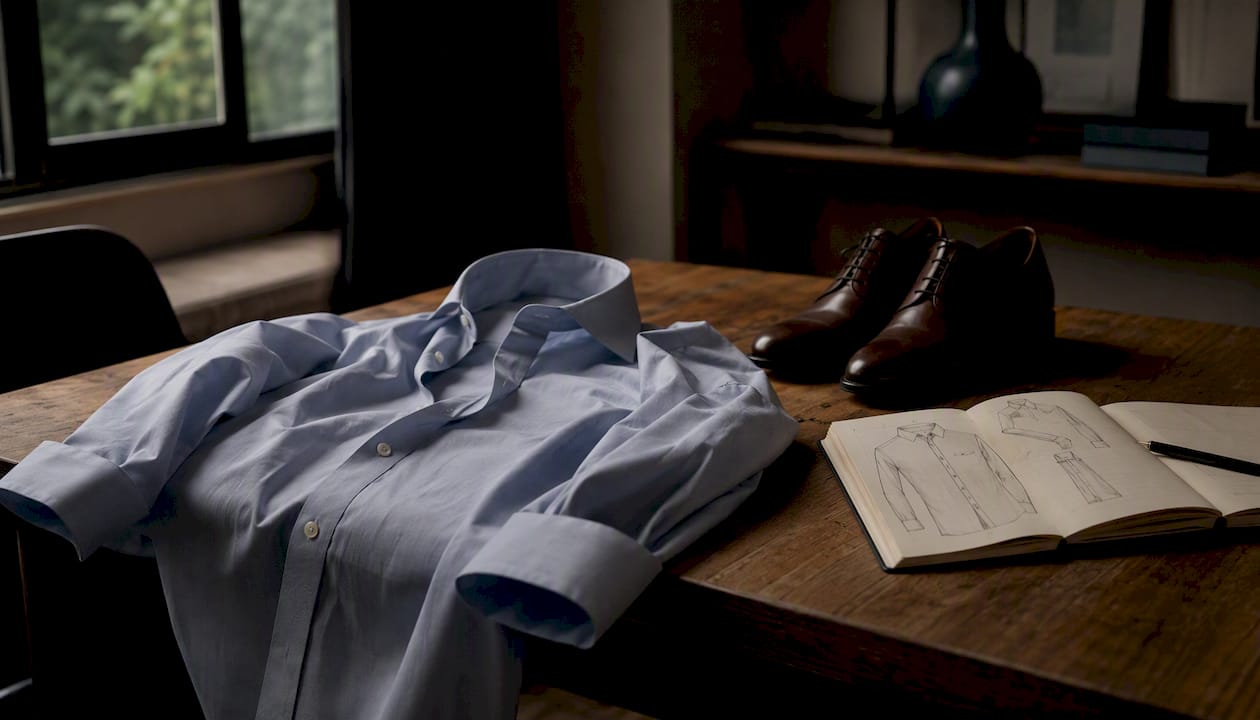
Pro Tip: If your shirt has two buttons on the barrel cuff, use the inner button for a slimmer fit and the outer for a looser one. Most men default to the outer button and end up with a cuff that gaps slightly.
The fit rule for barrel cuffs is simple: the cuff should sit at the wrist bone, not slide up the forearm or hang past the thumb. When buttoned, you should be able to slip two fingers inside comfortably.
Pros: No cufflinks required, easy to dress up or down, lower maintenance, travel-friendly, widely available. Cons: Less formal than French cuffs, limited as a style statement, no opportunity for cufflink expression.
French cuffs: construction, formality, and how to wear them
A French cuff, also called a double cuff, extends the sleeve fabric to roughly twice the length of a barrel cuff, then folds back on itself. The folded cuff has link holes on both sides but no buttons, so cufflinks are not optional — they are structural. The result is a thicker, more substantial band at the wrist that carries a quiet authority.
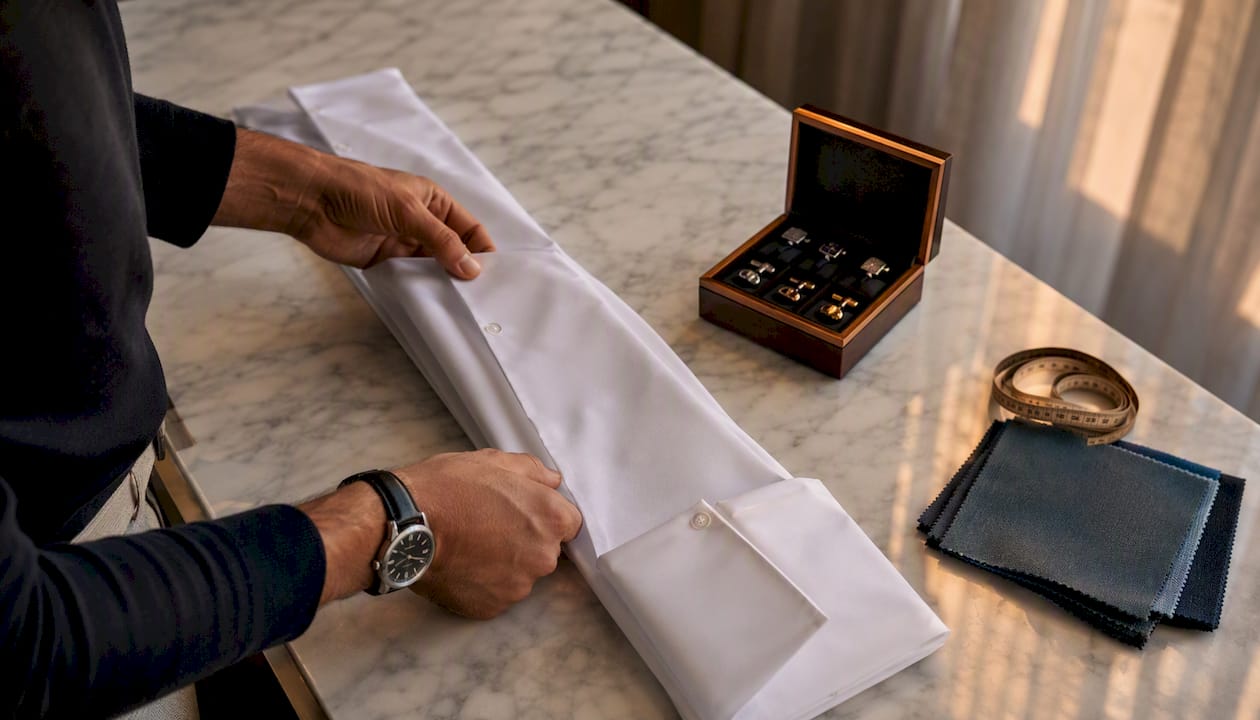
Two folding styles exist. The “kissing” fold brings the two layers together so the edges meet flush. The “stacked” fold layers one slightly over the other for a more casual interpretation. Most tailors recommend the kissing fold for formal occasions.
When to wear French cuffs
French cuffs belong at black-tie events, weddings, and formal galas by tradition. Modern style thinking, however, has expanded their territory. Style authorities note a resurgence in French cuffs for smart office wear, provided the rest of the outfit stays restrained. A French cuff shirt under a well-cut suit, with a simple tie and understated cufflinks, reads as intentional rather than overdressed. They can also work under sweaters or blazers, as long as there is enough wrist room to accommodate the folded fabric.
How to put on French cuffs
- Button the shirt and slide it on before fastening the cuffs.
- Fold the cuff back on itself so the link holes on both layers align.
- Hold the cuff in place and push the cufflink through all four holes (two from each layer).
- Orient the decorative face of the cufflink forward, so it faces outward when your arms hang at your sides.
- Check that the cuff sits at the wrist bone, not above it.
Styling French cuffs well
- Keep cufflinks as the focal point: a bold cufflink pairs with a plain shirt and solid tie.
- Match metal tones to your watch, belt buckle, and shoe hardware.
- Avoid pairing patterned cufflinks with a patterned shirt — one pattern at a time.
- Cufflinks serve as personal expression; pairing loud cufflinks with busy patterns tends to overwhelm an outfit.
Pro Tip: Sterling silver or gold-toned cufflinks in a simple bar or knot design work with almost any formal shirt. Save novelty cufflinks for occasions where the conversation piece is welcome.
Pros: Elevated formality, cufflinks as personal expression, richer visual weight at the wrist, a clear style statement. Cons: Requires cufflinks, takes longer to fasten, needs more sleeve room, less practical for travel.
Convertible cuffs and other cuff shapes worth knowing
A convertible cuff includes both a sewn-in button and an extra buttonhole, so it can be fastened either way. Wear it with a button on a casual day; swap in cufflinks when the occasion calls for more. It is the most practical middle ground for men who want one shirt to serve multiple formality levels.
Beyond the two main types, a few other cuff shapes appear in tailoring:
- Mitered cuff: a barrel cuff with angled corners rather than rounded ones; slightly more formal in appearance, common on business dress shirts.
- Cocktail cuff: a wide, stiff single cuff that fastens with cufflinks, similar to a French cuff but without the fold — a less common but striking choice for evening wear.
- Single-link cuff: a narrow cuff with a single link hole on each side, fastened with a single cufflink; associated with British tailoring tradition and a very specific formal aesthetic.
Choose a convertible cuff when you want flexibility without committing to a full French-cuff wardrobe. Choose a mitered cuff when you want a sharper business look from a barrel-style shirt. Cocktail and single-link cuffs are niche choices best left to men who already know their way around a cufflink drawer.
Cufflinks: types, how to put them on, and styling rules
Cufflinks come in four main forms, each suited to different contexts.
- Fixed-back (bullet back): the most common type; a toggle flips flat to insert, then flips back to lock. Reliable and easy to use.
- Toggle (whale-back): a flat bar swings perpendicular to the post for fastening. Slightly bulkier but very secure.
- Silk knots: braided silk loops that pass through the link holes. Casual, colorful, and inexpensive — good for everyday French-cuff wear.
- Button covers: snap over existing buttons on a barrel-cuff shirt to mimic the look of cufflinks. A practical, low-commitment option when you want a lifted look without owning French-cuff shirts.
How to insert cufflinks
- Fold the French cuff back so all four link holes align.
- Hold the cuff steady with one hand.
- Insert the cufflink post through all four holes from the outside in.
- Flip or toggle the back mechanism to lock it in place.
- Adjust so the decorative face sits forward when your arm is at rest.
Styling rules: Match metal tone to your watch and belt hardware. Let the cufflink be the standout piece, keep shirt and tie patterns simple when the cufflink is expressive. For storage and travel, a cufflink case keeps pairs together and protects the finish.
Pro Tip: Silk knots are the ideal entry point for men new to French cuffs. They cost very little, come in every color, and let you practice the folding and fastening routine before investing in metal cufflinks.
How do you choose between French and barrel cuffs?
The decision comes down to five practical questions.
- What is the occasion? Black tie, weddings, and formal galas call for French cuffs. Business-casual and daily office wear favor barrel cuffs.
- How often will you wear cufflinks? If you do not own cufflinks and have no interest in them, a barrel or convertible cuff is the honest choice.
- Does your jacket sleeve allow for the extra bulk? A too-tight jacket sleeve will bunch over a folded French cuff. Check sleeve room before committing.
- Are you traveling? Barrel cuffs win on convenience, no accessories to lose, easier to pack and press.
- Do you want the shirt to do double duty? A convertible cuff handles both roles. A dedicated French-cuff shirt does one thing very well.
| Criteria | French cuff | Barrel cuff |
|---|---|---|
| Construction | Double-length, folds back, link holes only | Single-layer, sewn-in buttons |
| Formality | Business formal to black tie | Business casual to smart business |
| Fastening | Cufflinks required | Buttons (1–2), no accessories needed |
| Convenience | Lower — more steps, accessories required | High — quick to fasten, travel-ready |
| Sleeve room needed | Extra quarter to half inch recommended | Standard sleeve length sufficient |
| Best occasion | Weddings, galas, boardroom presentations | Daily office, business-casual, travel |
Red flags for French cuffs: jacket sleeves that fit snugly at the wrist, no cufflink storage in your travel kit, a wardrobe that is primarily casual, or a lifestyle that demands speed in the morning.
Why bespoke shirts make cuff choices easier
Cuff fit is one of the details that off-the-rack shirts almost never get right. A standard sleeve length assumes a standard wrist, which rarely matches the man wearing it. French cuffs, in particular, demand precision: too short a sleeve and the folded cuff rides up; too tight a jacket sleeve and the extra fabric has nowhere to go.
At RON & RICH, every bespoke shirt begins with a precise sleeve-length measurement taken with the arm extended, so the cuff lands exactly at the wrist bone. Clients choosing French cuffs receive that additional sleeve allowance as a matter of course. Those who prefer flexibility can opt for a convertible cuff, which our tailors fit with the same care as any other cuff style. Fabric weight, cuff width, and the number of link holes are all discussed during the consultation — details that a rack shirt simply cannot offer.
The bespoke tailoring process at RON & RICH covers every one of these variables in a single fitting appointment, from initial measurements to cuff-style preference and fabric selection.
Key Takeaways
French cuffs signal deliberate formality through their double-length construction and cufflink fastening, while barrel cuffs offer everyday practicality with single-layer fabric and sewn-in buttons.
| Point | Details |
|---|---|
| Construction difference | French cuffs fold back and require cufflinks; barrel cuffs are single-layer and button closed. |
| Formality range | French cuffs suit black tie and weddings; barrel cuffs cover business-casual to smart business. |
| Sleeve room matters | French cuffs need an extra quarter to half inch of sleeve length to sit cleanly under a jacket. |
| Convertible cuffs | A convertible cuff accepts both buttons and cufflinks, offering the most flexibility for mixed wardrobes. |
| Ronandrich bespoke shirts | RON & RICH bespoke shirts are measured and fitted for precise cuff placement, sleeve length, and cuff-style preference. |
A tailor’s note on the mistakes men make with French cuffs
The most common error I see is a man wearing a French-cuff shirt under a jacket that was not cut with that extra fabric in mind. The folded cuff bunches at the wrist, the jacket sleeve rides up, and the whole effect works against him. French cuffs are not difficult to wear but they do require that the jacket and shirt were designed to work together.
The second mistake is treating cufflinks as an afterthought. A man will spend real money on a French-cuff shirt, then reach for the first pair of cufflinks he finds. The cufflink is the visible element; it deserves the same consideration as the tie or the pocket square. Silk knots are a perfectly respectable choice for daily wear, they are understated, they come in colors that coordinate easily, and they remove the anxiety of matching metals.
Sleeve show matters here too. A French cuff should peek roughly half an inch past the jacket sleeve, the same as a barrel cuff. If it disappears entirely, the whole point of the French cuff is lost. If it shows too much, it reads as a fit problem rather than a style choice.
Ron & Rich bespoke shirts: getting your cuff fit right

A well-chosen cuff style only works when the shirt is cut to match. RON & RICH bespoke shirts are built from a precise set of measurements; sleeve length, cuff width, and wrist circumference among them, so the cuff sits exactly where it should, every time. Whether you prefer the clean authority of a French cuff, the everyday ease of a barrel cuff, or the flexibility of a convertible, our tailors discuss every option during your fitting and build the shirt around your actual wardrobe and lifestyle.
The shirting collection at RON & RICH covers the full range of cuff styles in a selection of fabrics suited to both formal and smart-casual wear. To begin with a measurement appointment and a cuff-style consultation, visit our bespoke tailoring page and book your fitting.
Useful sources
- Wearing French Cuffs On Shirts: How, When, & Why | Gentleman’s Gazette — barrel cuff prevalence and button-count guidance
- How to wear French cuff shirts | The Manual — modern styling and smart-casual use
- 12 reasons to wear cufflinks | Deakin & Francis — cufflink styling principles
- Button covers | Trendhim — button covers as a practical alternative