Athletic Fit Suits for Muscular Men: The Best Routes
For most men with an athletic or muscular build, made-to-measure or bespoke tailoring delivers the most reliable combination of mobility, proportion, and a refined silhouette. Off-the-rack suits with targeted alterations remain a practical, faster option when budget or timeline is the priority. The decision comes down to three questions: How much does fit precision matter? How much time do you have? And how unusual are your proportions?
Quick picker:
-
Off-the-rack + tailoring: Your chest and shoulders fit a standard size, and you need the suit within a few weeks.
-
Made-to-measure (MTM): Your chest-to-waist drop exceeds what standard sizing accommodates, or you want a cleaner result without the full bespoke investment.
-
Bespoke: Your proportions are genuinely unusual (very broad shoulders relative to waist, large thighs, long torso), or you want a garment built precisely around your body from the first cut.
Pro Tip: When trying on any jacket off-the-rack, prioritize a natural shoulder seam and enough room across the chest to button without pulling. Chest and armhole alterations are among the most difficult and expensive a tailor can make; shoulder width and sleeve length are far simpler.
Table of Contents
-
What technical features should you look for in athletic-fit suits?
-
How to measure yourself and which tailoring adjustments matter most
-
Which fabrics and construction choices work best for athletic builds?
What does ‘athletic fit’ actually mean for suits?
Athletic fit, sometimes labeled “muscle fit” or “athletic cut,” describes a jacket engineered with extra room across the chest and shoulders and a noticeably tapered waist. The armholes sit higher than in a classic or modern fit, which keeps the sleeve from dragging when you raise your arms. The chest is cut fuller to accommodate developed pectorals and lats, while the waist is suppressed to prevent the boxy silhouette that plagues muscular men in traditional cuts.
The differences between fit categories matter most at the point of purchase:
-
Modern fit:A middle ground. Slightly tapered at the waist, but not dramatically so. Works for average builds; still gaps at the waist for most athletic physiques.
-
Slim fit:Reduced room throughout, including the chest and thighs. Flatters lean frames but constricts muscular builds across the shoulders and upper arms.
-
Athletic fit:Fuller chest and shoulders, higher armholes, tapered waist. Built for the proportions that standard sizing ignores.
“Athletic fits prioritize chest and shoulder room with a tapered waist, whereas slim fits reduce room throughout and classic fits add room at the waist, the distinction is not just aesthetic, it determines whether the jacket can close comfortably.”, Men’s Wearhouse fit guide
On a product page, look for terms like “athletic,” “muscle fit,” “room in the chest,” or a listed stretch percentage. A stated elastane or spandex content within a typical range is a reliable signal that the fabric will move with you.
What technical features should you look for in athletic-fit suits?
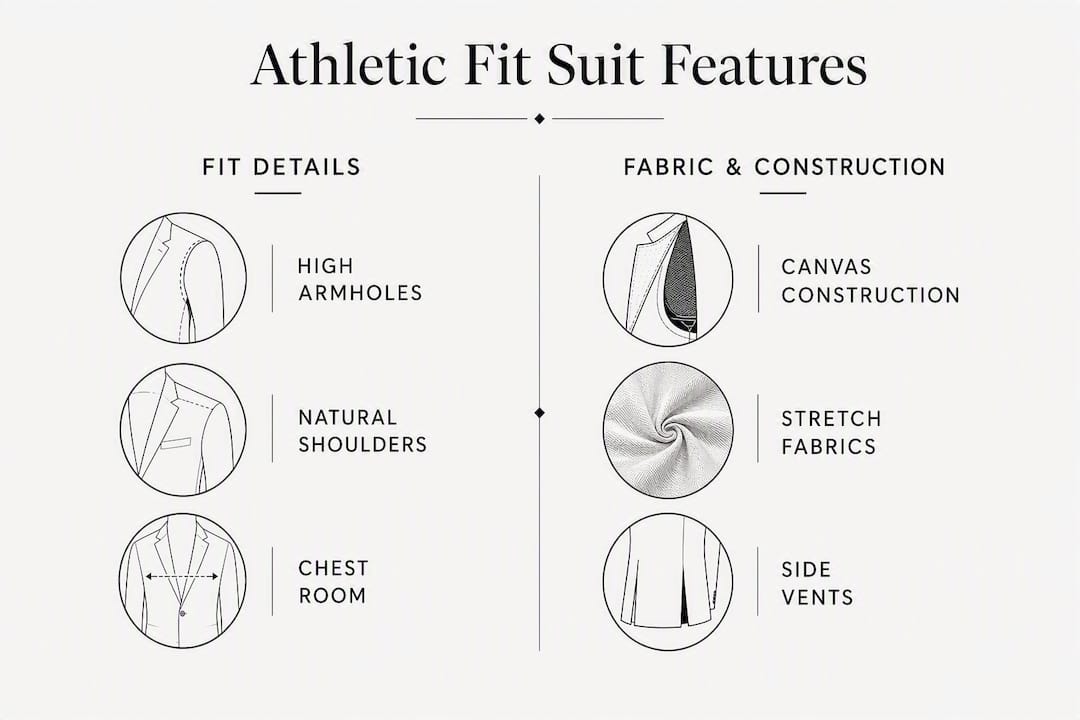
The label “athletic fit” varies by brand. The construction details are what actually determine whether a suit works on a muscular frame.
Fit and cut details
Higher armholes are the single most important structural feature. A low armhole forces the entire jacket to shift when you raise your arm, pulling the back out of shape. Higher armholes keep the jacket anchored. Pair that with a slightly fuller chest panel and a suppressed waist seam, and the jacket follows the body’s natural taper rather than fighting it.
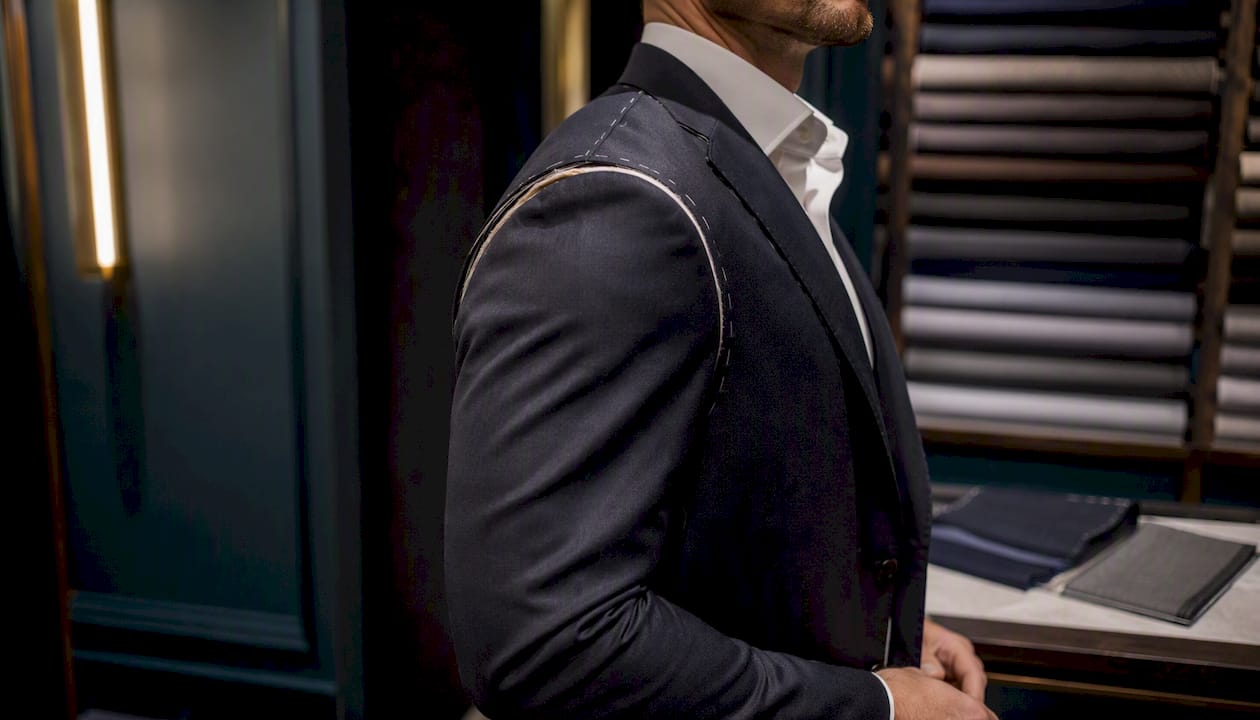
Natural shoulder construction, with minimal or no padding, allows the jacket to sit cleanly over broad shoulders without adding artificial width. GQ’s coverage of Henry Cavill’s suit choices makes this point directly: stylist commentary consistently favors single-breasted jackets with minimal shoulder padding to preserve a refined silhouette on broad physiques.
Construction: canvas vs. fused, vents, and sleeves
Half-canvassed or full-canvassed construction allows the jacket’s chest to mold to your torso over time. Fused construction bonds the interlining to the outer fabric, which limits that adaptation and can bubble after cleaning. For athletic builds, canvas construction is worth the investment because the chest panel needs to conform to an unusual shape.
Side vents allow freer movement of the hips and seat than a single center vent. Two-piece sleeves give a cleaner roll at the elbow and more natural movement than a single-piece construction.
Pro Tip: When reading a product page, look for “half canvas,” “full canvas,” or “floating chest piece” as construction descriptors. “Fused” or no construction mention at all usually indicates a bonded interlining.
How to measure yourself and which tailoring adjustments matter most
Getting the measurements right before you walk into a store or book a fitting saves time and prevents the most common fit errors.
Essential measurements for athletic builds
| Measurement | How to take it | Why it matters for fit |
|---|---|---|
| Chest (fullest point) | Tape under arms, across fullest part of chest | Determines jacket size; the starting point for all other adjustments |
| Shoulder width | Seam to seam across the back | Most difficult to alter; must be right off the rack or built to spec |
| Bicep circumference | Flexed, around the fullest part of the upper arm | Affects sleeve width; often needs letting out on muscular arms |
| Sleeve length | Shoulder seam to wrist bone | Simple alteration; aim for ½ inch of shirt cuff showing |
| Chest-to-waist drop | Chest minus natural waist | A drop greater than 8 inches signals MTM or bespoke territory |
| Seat (trousers) | Around the fullest part of the hips/glutes | Athletic builds often need a full seat with a tapered thigh |
| Thigh circumference | Around the fullest part of the upper thigh | Determines trouser width; muscular thighs frequently require adjustment |
| Trouser rise | Crotch seam to waistband | A higher rise accommodates developed glutes and prevents pulling |
Common alteration checklist for muscular frames
-
Waist suppression on the jacket: Taking in the side seams to follow the natural taper from chest to waist.
-
Sleeve shortening: Bringing the sleeve to the correct break at the wrist; straightforward and inexpensive.
-
Sleeve widening: Letting out the sleeve seam to accommodate larger biceps; possible within the seam allowance.
-
Trouser seat adjustment: Letting out or taking in the seat seam to fit developed glutes without excess fabric at the front.
-
Trouser thigh tapering: Reducing fabric below the seat to create a clean line through the knee.
-
Trouser rise adjustment: Raising the rise to prevent the waistband from sitting below the natural waist when seated.
What to check when trying on
For the jacket: the shoulder seam should sit at the edge of your shoulder, not drooping onto the arm. You should be able to cross your arms in front of your chest without the back riding up. The chest should button without pulling, with the lapels lying flat. For tailored trousers, the seat should feel comfortable when seated, with no horizontal pulling across the thighs.
Pro Tip: Bring a dress shirt you actually wear to any suit fitting. The shirt’s collar and shoulder seam affect how the jacket sits, and fitting over a T-shirt gives you an inaccurate read on sleeve length and chest room.
How do you choose between off-the-rack, MTM, and bespoke?
The right path depends on how far your proportions deviate from standard sizing and how much precision you need.
| Approach | Typical SG price range | Lead time | Fit advantage | Best for |
|---|---|---|---|---|
| Off-the-rack + tailoring | Mid-range price suit plus alterations | Short lead time | Good if chest/shoulder fit off the rack | Moderate athletic build; standard proportions |
| Made-to-measure | Higher price range | Several weeks lead time | Built to your measurements; limited style choices | Chest-to-waist drop beyond standard sizing; defined physique |
| Bespoke | Premium price range | Extended lead time | Fully custom pattern; multiple fittings | Unusual proportions; investment-grade wardrobe |
The bespoke process at RON & RICH follows a staged workflow: initial measurements, a basted fitting to test core proportions, interim adjustments, and a final fitting. That sequence is what makes bespoke reliably superior for unusual proportions. No single fitting can achieve what the iterative process delivers.
When testing off-the-rack, the chest and shoulders must fit without alteration. Waist suppression, sleeve length, and trouser adjustments are all achievable. Chest and armhole changes are not, at least not without a cost that approaches MTM pricing.
Which fabrics and construction choices work best for athletic builds?
Fabric choice affects how a suit moves, breathes, and holds its shape over a muscular frame.
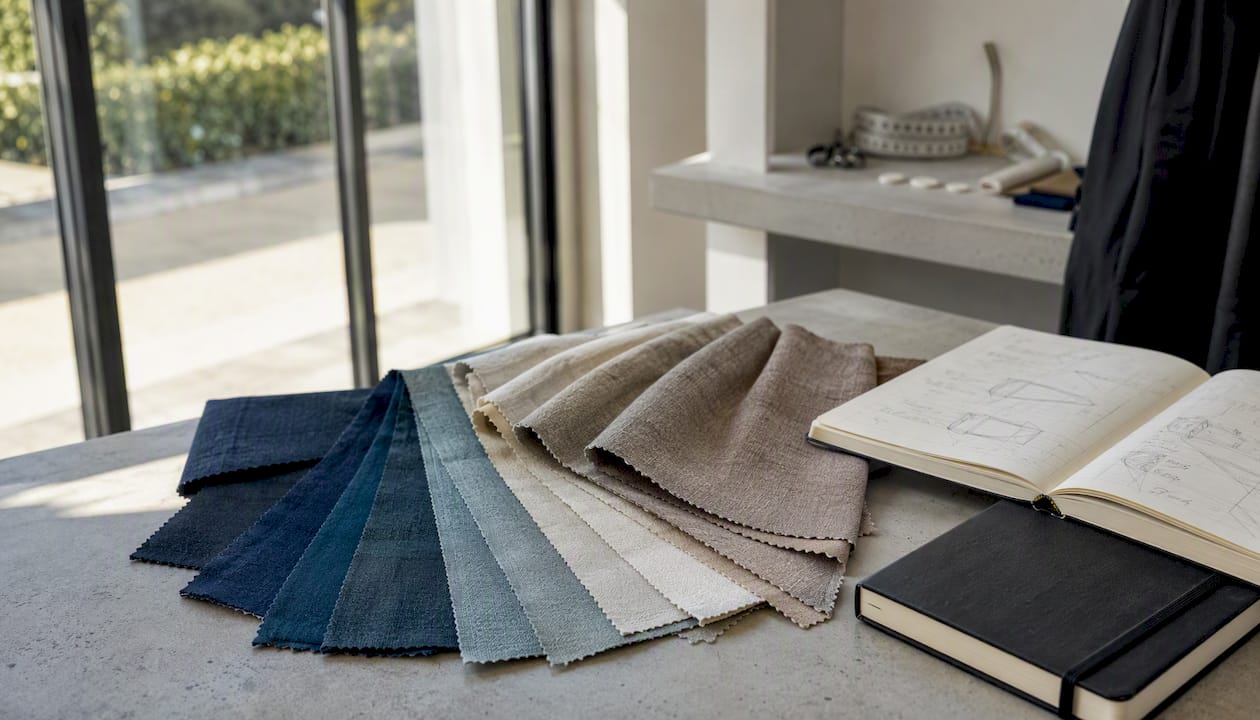
Lightweight wools give the best combination of drape, breathability, and stretch. Tropical wools, woven with an open structure for warm-weather wear, are another strong option for athletic builds because they resist wrinkling under movement and breathe well. Technical blends, which incorporate performance fibers alongside wool, offer wrinkle resistance and moisture management at the cost of some visual richness.
Heavier fabrics, anything above 330grams can look impressive on the bolt but create problems on a muscular frame. They add visual bulk to an already broad chest and resist the natural movement of the body, which causes pulling and distortion at the armholes and seat.
On construction, Ron & Rich’s approach to suit-making prioritizes canvas construction and fabric selection as the foundation of a garment that fits and ages well. A full-canvassed chest piece allows the jacket to conform to the body’s shape over time, which matters especially for athletic builds where the chest-to-waist ratio is pronounced.
Expert tailors consistently recommend minimal shoulder padding for muscular men. Excessive padding creates a blocky silhouette and prevents the jacket from following the body’s natural lines. Natural-shoulder construction, combined with canvas, allows the jacket to sit and shape correctly over a broad chest.
Pro Tip: Ask your tailor or retailer whether the jacket is half-canvassed or fused before committing. A half-canvassed jacket will outlast and outperform a fused jacket at the same price, particularly after dry cleaning.
Practical styling rules that flatter an athletic frame
A well-fitted suit can still look off if the styling choices work against the body’s proportions.
Do:
-
Choose single-breasted jackets with two or three buttons; they create a clean vertical line.
-
Opt for a moderate lapel width, roughly 3–3.5 inches, which balances broad shoulders without adding horizontal mass.
-
Wear trousers with a slightly higher waist break to elongate the leg visually.
-
Keep tie width proportional to lapel width; a 3-inch tie with a 3-inch lapel reads as balanced.
Avoid:
-
Double-breasted jackets, which add horizontal volume to an already wide chest and torso.
-
Heavy patterns like large windowpanes or bold plaids, which amplify the chest’s visual mass.
-
Exaggerated shoulder padding, which turns a broad physique into a blocky one.
-
Overly slim trousers that constrict the thigh and create an imbalanced silhouette.
How you dress the suit matters, too. A well-fitted custom shirt with the correct collar spread and a clean shoulder seam prevents the jacket from sitting awkwardly at the neck. A spread or semi-spread collar balances a broad face and neck better than a narrow point collar.
Pro Tip: A pocket square in a simple fold, not a puff, adds visual interest at the chest without adding width. Keep it understated: white linen or a simple fold in a complementary color.
When athletic fit goes wrong and what to choose instead
Athletic fit is not the right answer for every muscular or broad-shouldered man.
When to reconsider athletic fit:
-
A larger midsection or prominent belly: athletic fit suppresses the waist, which highlights rather than accommodates a fuller torso. A classic or traditional fit with wider lapels creates a more balanced silhouette and avoids fabric strain across the midsection.
-
Very long torso relative to leg length: athletic-fit jackets are often cut for average torso proportions; a long torso can leave the jacket hem sitting too high.
-
Extremely broad shoulders with a narrow waist: standard athletic-fit patterns may still not accommodate this ratio, and off-the-rack athletic fit will gap or pull. MTM or bespoke is the only reliable solution.
Common fitting errors to catch in-store:
-
Horizontal pulling lines across the chest when the jacket is buttoned: the chest is too small.
-
Armhole constriction that prevents you from raising your arms comfortably: the armhole is too low or too tight.
-
Collar gap at the back of the neck: the jacket back length or shoulder pitch needs adjustment.
-
Trouser pulling across the thighs when walking: the thigh circumference is insufficient.
When athletic fit fails, a modern fit with targeted alterations often works better than a classic fit. Modern fits retain some waist suppression while offering more room through the chest and thighs, and they alter more predictably than classic fits, which tend to have less seam allowance for taking in.
Key Takeaways
For athletic and muscular builds, made-to-measure or bespoke tailoring delivers the most reliable fit, but off-the-rack suits with targeted alterations remain a practical option when the chest and shoulders fit without adjustment.
| Point | Details |
|---|---|
| Prioritize shoulder and chest fit | These are the hardest alterations; buy or build to fit here first, then adjust the rest. |
| MTM starts at a chest-to-waist drop of 8+ inches | Standard sizing rarely accommodates this ratio; MTM or bespoke is the practical solution. |
| Canvas construction outperforms fused | Half or full canvas molds to an athletic chest over time; fused interlinings resist and bubble. |
| Lightweight wool with 2–4% elastane | This blend delivers drape, breathability, and the stretch muscular frames need for daily wear. |
| Ron & Rich bespoke process | A staged fitting workflow (basted, interim, final) makes Ron & Rich the recommended route for unusual proportions. |
A tailor’s perspective on dressing the athletic frame
There is a tendency among athletic men to treat fit as a problem to be solved once and then forgotten. In our experience, the opposite is true. The first suit a client has made for an athletic build is rarely the best one. It is the one that teaches him what he actually needs.
Most clients arrive having spent years buying jackets a size too large to accommodate their chest, then living with a suit that fits nowhere else. The first MTM or bespoke commission corrects the obvious errors: the shoulder sits properly, the chest closes cleanly, the waist follows the body. But it is the second or third garment, after the client has worn the first and understood what still bothers him, that becomes the definitive piece.
The fitting process matters more for athletic builds than for any other body type, precisely because the proportions are unusual. A basted fitting, where the jacket is only half-constructed, reveals how the pattern interacts with the body before any permanent work is done. That stage is where the real tailoring happens. Adjustments made at the basted fitting cost nothing beyond time; the same changes after final construction are expensive and sometimes impossible.
Expect two to three fittings for a bespoke commission and at least one for MTM. Lead times of 8–16 weeks for bespoke and 4–8 weeks for MTM are standard. The timeline is not a delay; it is the process working correctly.
Ron & Rich tailored solutions for athletic frames
Ron & Rich has worked with athletic and muscular clients since master tailor Richard Fan founded the house in 1979. The challenge of dressing a broad chest and narrow waist in a garment that reads as refined rather than strained is one our tailors address with every commission.
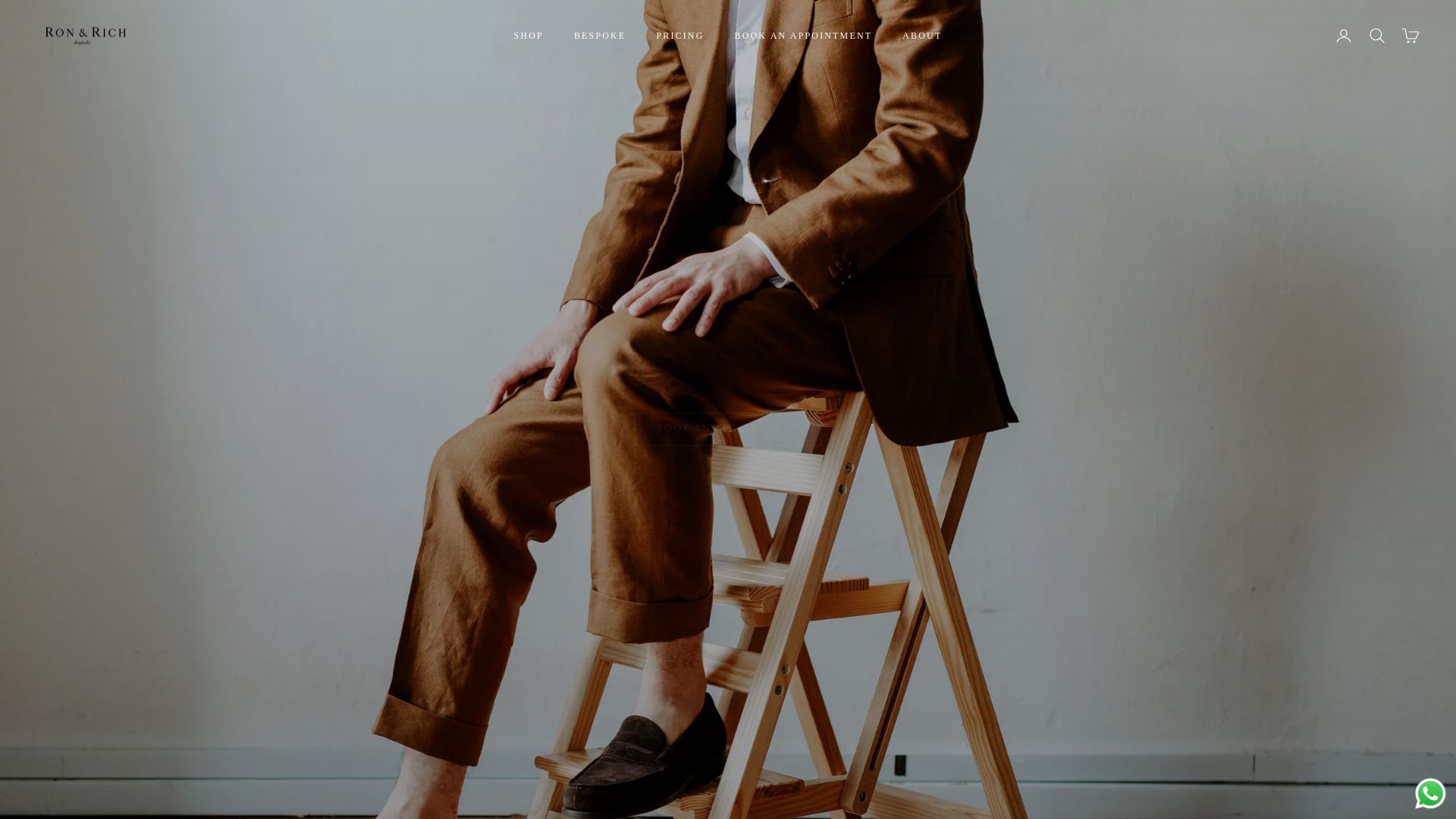
Our bespoke suits are built from a personal pattern, constructed through multiple fittings, and finished to the exact proportions of your body. For clients who want a faster path, our ready-to-wear collection is designed with athletic proportions in mind and serves as a practical entry point before a full bespoke commission. Every garment, whether bespoke or ready-to-wear, is made with canvas construction and fabric selections chosen for movement, drape, and longevity.
The process begins with a consultation. Mention your occasion and your questions and we will advise what is best for your consideration. Book your consultation at ronandrich.com/pages/bespoke.